


Graduation Rings 2026: Class, Signet & Birthstone Compared
Are you on the lookout for the best graduation rings for yourself or a loved one? This guide walks through all three major styles of graduation rings, the metals and stones worth understanding before you buy, and the questions that actually matter when you are trying to decide.
A Short History of the Graduation Ring
The graduation ring, as a recognizable tradition, traces back to 1835, when the United States Military Academy at West Point issued the first documented class rings to its graduating cadets.
The tradition spread slowly through other American universities across the late 1800s. And by the mid-20th century, it had migrated down into high schools as well.
Now, the category has expanded well past the traditional chunky school ring. Independent jewelers and direct-to-consumer brands have introduced graduation signet rings, birthstone rings, and stacking bands as graduation-appropriate alternatives.
The market has moved toward personalization over institutional branding, which is a meaningful shift. Graduating in 2026 means you have more genuinely good options than any previous generation.
The 3 Main Types of Graduation Rings
Traditional Class Ring
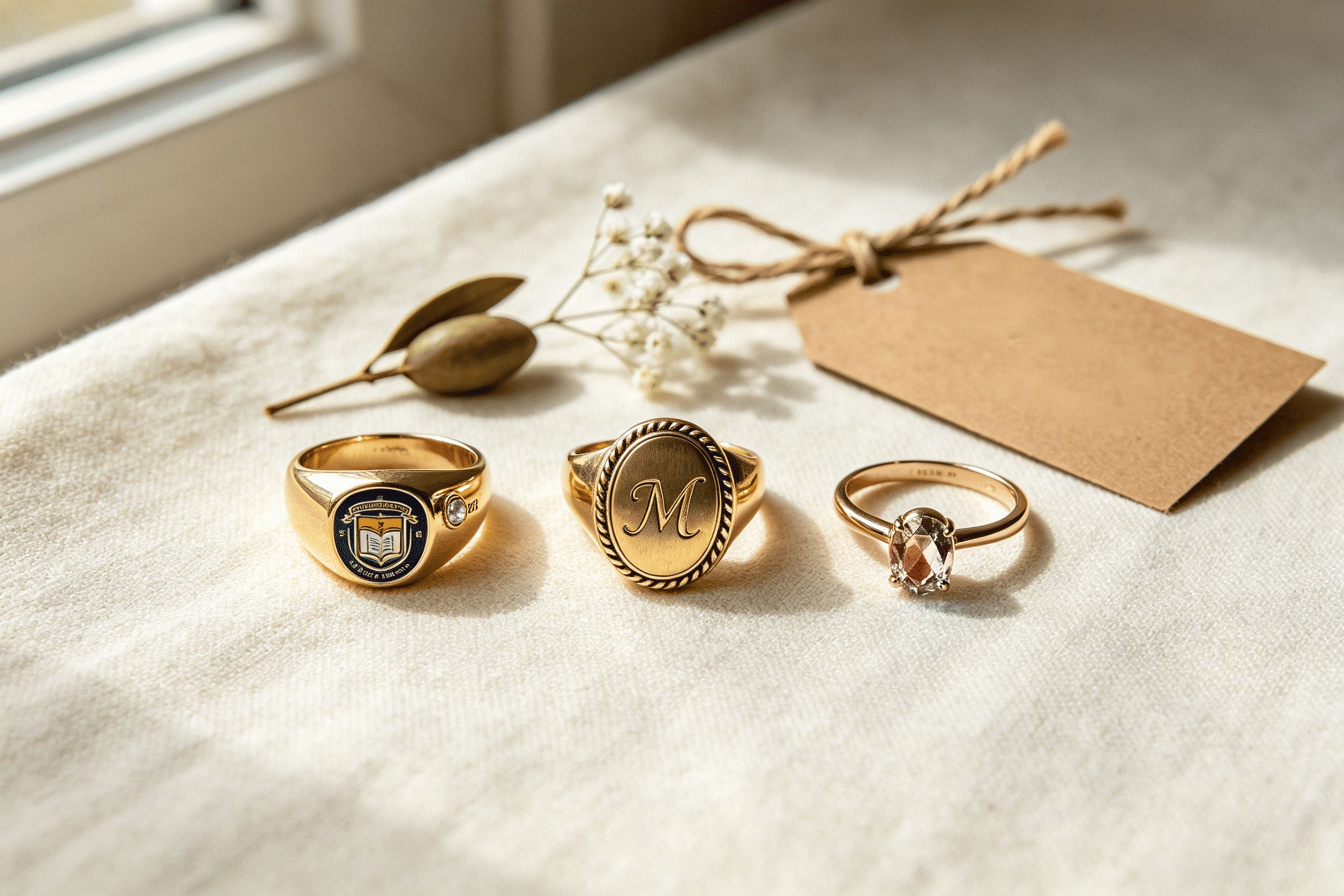
It is typically a large ring with a dome top. It comes with the school name running along the band, a central stone in the school color, and engravings on both sides that can reflect sports, clubs, or graduation year.
| Aspect | Details |
| Pros | Strong sentimental value; Highly customizable; School-specific options from established vendors. |
| Cons | Can feel dated to younger graduates; Bulky for everyday wear; Low resale value due to personalization. |
| Who It’s For | Graduates who value school pride and tradition, as well as parents or grandparents seeking a meaningful commemorative gift. |
| Average Price | $150–$600, with higher prices for premium metals, stones, and custom designs. |
Signet Ring
The signet ring has a flat or slightly raised top surface designed to be engraved with an initial, monogram, family crest, or simple design.
| Aspect | Details |
| Pros | Suitable for everyday wear; Professional-looking; Timeless design; And often becomes a favorite daily ring. |
| Cons | Less recognizable as a graduation gift; Fewer customization options; And lacks a strong school connection. |
| Who It Is For | Graduates who prefer a stylish; A versatile ring that they can wear daily; Especially in professional settings. |
| Average Price | $80–$400, depending on the material and level of customization. |
Birthstone Graduation Ring
A birthstone graduation ring centers a colored gemstone that corresponds to the graduate’s birth month rather than their school color.
| Aspect | Details |
| Pros | Personal and meaningful; Versatile for any occasion; Stylish; And suitable for long-term wear. |
| Cons | Not immediately recognizable as a graduation gift and has a more personal than school-related connection. |
| Who It Is For | Gift buyers seeking a meaningful; Wearable pieces and graduates who already enjoy jewelry and have a defined personal style. |
| Average Price | $60–$350, depending on the gemstone and metal choice. |
Quick comparison across all three styles:
| Type | Avg Price | Personalization | Wearability | Best For | Style |
| Traditional Class Ring | $150 to $600 | School name, year, stone, sport | Occasional / formal events | School-proud graduates | Bold, chunky signet |
| Signet Ring | $80 to $400 | Monogram, crest, initials | Daily wear, professional | Minimalist professionals | Slim, timeless band |
| Birthstone Ring | $60 to $350 | Stone color, metal, engraving | Daily or casual wear | Gift recipients & style-first grads | Delicate, feminine, or modern |
How to Choose a Class Ring Style?
The following three questions help you choose a ring without overcomplicating it.
Question 1: Will this be worn after the first month?
If the honest answer is a “no”, go for a smaller investment in the traditional class ring category.
Question 2: Does the graduate have strong school pride?
Graduates who are likely to attend alumni events will get more out of a traditional class ring. Graduates who are ready to move forward and see the degree as a credential rather than an identity will usually prefer something less institution-specific.
Question 3: Is this a gift or a self-purchase?
Gift buyers tend to do better with the birthstone or signet style because those translate well without requiring insider knowledge about a person’s school, year, or activities. Self-purchases can go in any direction because the buyer already knows what they want to remember.
For more ideas on what to pair with a ring, the best graduation gifts guide covers a wide range of price points and styles.
Metal and Stone Buying Guide
The material a ring is made from affects how it looks on day one and how it holds up over years of wear. Here is what actually matters.
10k vs 14k vs 18k Gold
| Gold Karat | Gold Content | Key Characteristics | Best For |
| 10K Gold | 41.7% gold | Most durable and least expensive option. Traditional choice for college class rings due to its toughness and affordability. | Everyday wear, class rings, budget-conscious buyers |
| 14K Gold | 58.3% gold | Offers an ideal balance of durability, rich gold color, and affordability. Considered the preferred choice for most buyers. | Daily wear, most jewelry applications |
| 18K Gold | 75% gold | Features a warmer, deeper gold color but is softer and more susceptible to scratches than lower karat options. | Special-occasion rings and fine jewelry |
A more detailed breakdown of karat differences can be found in the difference between 14k and 18k gold.
Sterling Silver, White Gold, and Stainless Steel
| Material | Composition | Key Characteristics | Best For |
| Sterling Silver | 92.5% silver | Affordable, stylish, but tarnishes over time and needs polishing | Signet and birthstone rings |
| White Gold | Gold alloy + rhodium plating | Bright white look, similar to platinum; plating wears and needs replating | Fine jewelry, everyday wear |
| Stainless Steel | Iron alloy (chromium-based) | Very durable, scratch/tarnish resistant, very low cost, hard to resize | Casual, budget daily wear |
Genuine vs Lab-Grown vs Synthetic Stones
| Stone Type | What It Is | Key Traits | Best For |
| Genuine (Natural) Stones | Mined from the earth | Highest value and price; prized for authenticity. High-grade rubies, sapphires, and emeralds can be expensive | High-end, heirloom jewelry |
| Lab-Grown Stones | Created in controlled lab conditions | Chemically and physically identical to natural stones but far more affordable | Visually premium jewelry at lower cost |
| Synthetic/Simulated Stones | Made from different materials (e.g., cubic zirconia) | Mimic gemstone appearance but not the same material; very low cost, less durable under scrutiny | Budget jewelry focused on appearance |
Sizing a Graduation Ring
- Measure ring size when your hands are at a normal temperature.
- If your knuckles are noticeably wider than the base of your finger, choose a bigger size so the ring slides over the knuckle comfortably.
- If the ring you are ordering has a wide band (8mm or more), you may want to go up by a half size compared to your usual ring size.
- Use a ring sizer tool or visit a local jeweler, as nothing beats having a jeweler measure your finger with a physical ring mandrel.
10 Best Graduation Rings to Buy in 2026
These picks span all three styles and a range of budgets. Each has been selected based on craftsmanship, value, and suitability as a graduation piece.
1. Jostens Ultrium Class Ring
2. Herff Jones Luminary Series
3. Callie Personalized Signet Ring
4. Mejuri Dome Signet Ring
5. Catbird Birthstone Ring
6. James Avery Graduation Ring
7. Pandora Birthstone Ring
8. VRAI Lab Diamond Signet
9. Macy’s Personalized Class Ring
10. Brilliant Earth Birthstone Solitaire
Personalized Graduation Rings from Callie
According to National Jewelers, personalized jewelry is a trendy way to express emotions. For that, Callie offers a collection of graduation rings designed for graduates who want something they will actually wear beyond the ceremony. The best ones include:
Callie also carries a curated selection within the high school graduation gift ideas section for buyers shopping for a younger graduate. Rings in that section skew toward more accessible price points without sacrificing design quality.
Browse the full graduation rings collection at callie.com/graduation-rings.
Frequently Asked Questions
What is the average cost of a class ring in 2026?
Most high school class rings from major vendors like Jostens and Herff Jones fall between $150 and $600. Independent jewelers like Callie tend to start lower, with quality options available from $33 to $140.
Are class rings still worth it?
For graduates with strong school pride who want a lasting symbol of that chapter, a class ring delivers real sentimental value. For graduates who are unlikely to wear a large, school-branded ring regularly, the money may be better spent on a signet or birthstone ring that will be used.
What finger does a graduation ring go on?
The traditional convention in the United States is to wear a graduation ring on the right-hand ring finger. This distinguishes it from an engagement or wedding ring, which typically occupies the left ring finger.
Can you wear a class ring after graduation?
Yes. There is no rule against wearing a class ring long after the graduation ceremony.
What is the difference between a class ring and a signet ring?
A class ring is designed specifically to represent a graduating class at a particular school. It typically features the school name, graduation year, a colored stone, and personalized side engravings. A signet ring has a flat or lightly raised top engraved with an initial, monogram, or crest. It has no institutional affiliation by default.
Do colleges still issue class rings?
Some universities maintain formal class ring programs through official vendors, particularly military academies and schools with strong alumni traditions. Many colleges have moved away from issuing rings directly and instead direct students to approved vendors.
How long does it take to get a custom graduation ring?
Standard customized class rings through major vendors typically take four to six weeks from the time the order is placed. Boutique or independent jewelers with fully custom work can take eight to twelve weeks.